
 Contact
 Comment faire ses achats
Livraison
Guide d'achat
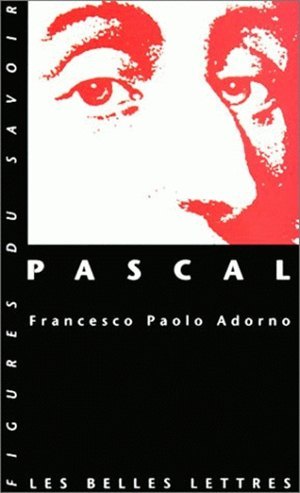
Pascal
 Français
 63 b
63 b
Jusqu'à 30 jours pour les retours
Les clients ont également acheté










 /
/
 Livre de poche
 42.58
€
42.58
€

 /
Livre de poche
9.70
€
/
Livre de poche
9.70
€




 /
Livre de poche
6.77
€
/
Livre de poche
6.77
€


 /
/
 Adobe ePub DRM
147.78
€
Adobe ePub DRM
147.78
€








Blaise Pascal (1623-1662), was a mathematician, surveyor and physician whom many perceive to be the precursor of contemporary science, defender of Catholicism and enemy of the Jesuits. He was a scathing polemicist who chose to live in seclusion, whose reputation has often been tarnished by legends surrounding his conflicts of conscience and his early death. This book's author strives to make us feel the incredibly contemporaneous nature of this author of the Pensées and of Essai pour les coniques. It is the thinker behind the images, whose theoretical invention was in no way hampered by his theological " prejudices ", who is considered here, in order to underscore the incredibly contemporary nature of this man. In this book, the author initially considers his anthropological views, which leads to the defining of reason as an acquisitive power arising from infinite approximation, a definition accepted in the most recent theories of knowledge. From there, the author examines his epistemology, by which we can rigorously construct the (still valid) conditions of a scientific experiment and which allows us to use probability as an element in calculations. Finally, the author moves on to Pascal's political views which arising from the multifaceted foundation of the believer's faith, despite the dilemmas which such views led to because of the contradictions between civil and religious life that they were unable to resolve make us aware of the contradictory nature of any social education. In this manner, the author strives to show that Pascal, tormented as he was, is more akin to us through his science than through his suffering...Francesco Paolo Adorno, whose doctorate is in literature, currently works with the University of Salerno [Italy], and is a member of the Editorial Board of the magazine Cités. He has published : Le style du philosophe : Foucault et le dire-vrai (1996).


À propos du livre
Français
Catégories

Offrez ce livre dès aujourd'hui
C’est simple
1 Ajouter au panier et choisir l'option Livrer comme cadeau à la caisse. 2 Nous vous enverrons un bon d'achat 3 Le livre arrivera à l'adresse du destinataireCeci pourrait également vous intéresser




 /
Livre de poche
37.82
€
/
Livre de poche
37.82
€

 /
Livre relié
110.45
€
/
Livre relié
110.45
€
 /
Livre de poche
48.55
€
/
Livre de poche
48.55
€









 /
Livre de poche
81.83
€
/
Livre de poche
81.83
€



 /
Livre de poche
11.62
€
/
Livre de poche
11.62
€



Bonjour ! Je suis Libroamiko, votre conseiller littéraire.
Comment puis-je vous aider ?