
 Contact
 Comment faire ses achats
Livraison
Guide d'achat
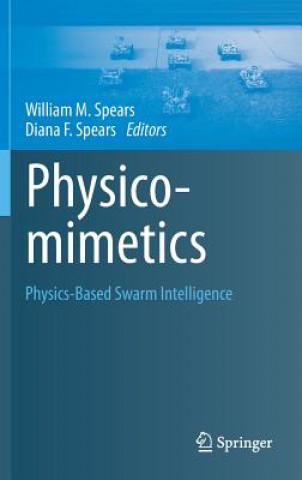
Physicomimetics
 Anglais
 249 b
249 b
Jusqu'à 30 jours pour les retours
Les clients ont également acheté







 /
/
 Livre de poche
 71.12
€
71.12
€





 /
Livre de poche
56.55
€
/
Livre de poche
56.55
€






 /
Livre de poche
22.45
€
/
Livre de poche
22.45
€

 /
Livre de poche
27.81
€
/
Livre de poche
27.81
€
 /
Livre relié
367.06
€
/
Livre relié
367.06
€







Standard approaches to understanding swarms rely on inspiration from biology and are generally covered by the term biomimetic . This book focusses on a different, complementary inspiration, namely physics. The editors have introduced the term "physicomimetics" to refer to physics-based swarm approaches, which offer two advantages: they capture the notion that nature is lazy , meaning that physical systems always perform the minimal amount of work necessary, an especially important advantage in swarm robotics; and physics is the most predictive science, reducing complex systems to simple concepts and equations that codify emergent behavior and help us to design and understand swarms. §This book consolidates over a decade of work on swarm intelligence and swarm robotics and contains __ chapters organized as follows: Part I introduces the concept of swarms and offers the reader a physics tutorial; Part II deals with applications of physicomimetics, in order of increased complexity; Part III examines the hardware requirements of the presented algorithms; Part IV demonstrates how the theory can be used to design swarms from first principles and provides a novel algorithm that handles changing environments; finally, Part V shows that physicomimetics can be used for function optimization, moving the reader from issues of swarm robotics to swarm intelligence. The book ends with a comprehensive index and bibliography, and a supporting website offers supplementary material, including simulation code, simulation videos, and videos of working robots.


À propos du livre
Anglais
Catégories

Offrez ce livre dès aujourd'hui
C’est simple
1 Ajouter au panier et choisir l'option Livrer comme cadeau à la caisse. 2 Nous vous enverrons un bon d'achat 3 Le livre arrivera à l'adresse du destinataireCeci pourrait également vous intéresser

 /
Livre relié
134.05
€
/
Livre relié
134.05
€











 /
Livre de poche
10.31
€
/
Livre de poche
10.31
€
 /
Livre de poche
23.26
€
/
Livre de poche
23.26
€
 /
Livre de poche
8.99
€
/
Livre de poche
8.99
€


 /
Livre de poche
25.08
€
/
Livre de poche
25.08
€




 /
Livre relié
74.86
€
/
Livre relié
74.86
€


Bonjour ! Je suis Libroamiko, votre conseiller littéraire.
Comment puis-je vous aider ?