
 Contact
 Comment faire ses achats

Livraison
Guide d'achat
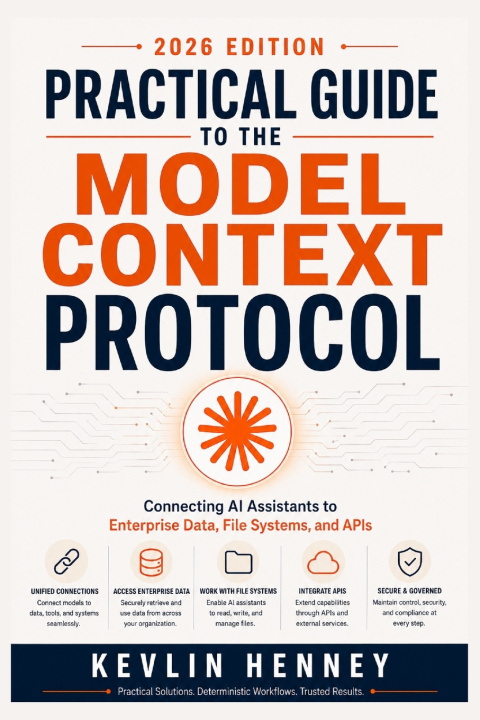
Practical Guide to the Model Context Protocol
Connecting AI Assistants to Enterprise Data, File Systems, and APIs
 Anglais
 39 b
 Nouveauté
Jusqu'à 30 jours pour les retours
Les clients ont également acheté


Connecting AI assistants to enterprise systems has traditionally required a growing collection of custom integrations. Databases, internal documentation, private files, ticketing systems, and other business applications often require separate authentication, error handling, security controls, and maintenance. As models and APIs evolve, maintaining these connections can become increasingly difficult.
Practical Guide to the Model Context Protocol introduces the Model Context Protocol as a standardized approach to connecting AI applications with external data and tools. Designed for integration engineers, backend developers, software architects, and technical teams, this guide explains the protocol's architecture and the practical considerations involved in building secure, production-ready integrations.
You will explore the three fundamental roles of the protocol: host, client, and server. The book explains how these components interact and how structured communication provides a consistent boundary between AI applications and the systems they need to access.
The guide provides a practical introduction to JSON-RPC 2.0 message flows, capability negotiation, transport mechanisms, and the protocol's core primitives. You will learn how resources can expose information, how reusable prompts can package institutional knowledge, and how tools can allow models to perform controlled actions through validated schemas.
Security is a central theme throughout the book. You will examine strict schema validation, read-only access patterns, credential scoping, canonical path resolution, and techniques for preventing unsafe access to local or enterprise resources.
The book also addresses deployment choices, from localized stdio transport for isolated environments to Streamable HTTP for shared infrastructure. Practical scenarios include connecting an AI interface to a PostgreSQL database and creating secure local-storage connectors with controlled path boundaries.
Protocol implementation highlights:
- JSON-RPC 2.0 Handshakes: Understand initialization and capability negotiation.
- Strict Schema Validation: Validate model-generated inputs before execution.
- Localized stdio Transport: Support isolated local integrations without network exposure.
- Streamable HTTP Integration: Build shared services for concurrent enterprise environments.
- Path-Security Enforcement: Establish controlled boundaries around filesystem access
Whether you are building a local AI integration or preparing enterprise infrastructure, this guide provides the architectural foundation needed to connect AI assistants with data, files, and APIs in a structured and security-conscious way.


À propos du livre
Anglais

Offrez ce livre dès aujourd'hui
C’est simple
1 Ajouter au panier et choisir l'option Livrer comme cadeau à la caisse. 2 Nous vous enverrons un bon d'achat 3 Le livre arrivera à l'adresse du destinataireBonjour ! Je suis Libroamiko, votre conseiller littéraire.
Comment puis-je vous aider ?