
 Contact
 Comment faire ses achats
Livraison
Guide d'achat
 Anglais
 228 b
228 b
Jusqu'à 30 jours pour les retours
Les clients ont également acheté










 /
/
 Livre de poche
 32.06
€
32.06
€











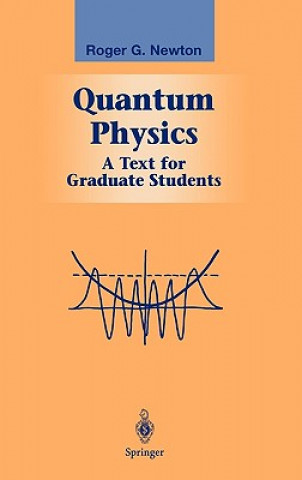
This text develops quantum theory from its basic assumptions, beginning with statics, followed by dynamics and details of applications and the needed computational techniques. The discussion is based on the view that the fundamental entities of the universe are not particles but fields, with the observed particles arising as their quanta. Quantum fields are thus introduced from the beginning, with a discussion of how they produce quanta that manifest themselves as particles. Most of the book, of course, deals with particle systems, as that is where most of the applications lie; the treatment of quantum field theory is confined to fundamental ideas and their consequences.For developing quantum dynamics, the author uses the Lagrangian technique with the principle of stationary action. The roots of this approach, which includes generating the canonical commutation rules, go back to a course taught by Julian Schwinger, filtered through many years of the authors own teaching.The text emphasizes that the wave function does not exist in physical three-dimensional space, but in configuration space, and it points out that the probabilistic features of the theory arise not from a lack of determinism but from the definition of the "state" of a system, so that many, though not all, of the counterintuitive aspects of quantum mechanics arise from its probabilistic nature and are shared by other probabilistic theories such as classical statistical mechanics.


À propos du livre
Anglais

Offrez ce livre dès aujourd'hui
C’est simple
1 Ajouter au panier et choisir l'option Livrer comme cadeau à la caisse. 2 Nous vous enverrons un bon d'achat 3 Le livre arrivera à l'adresse du destinataireCeci pourrait également vous intéresser
















 /
Livre de poche
20.23
€
/
Livre de poche
20.23
€


 /
Livre de poche
8.59
€
/
Livre de poche
8.59
€








Bonjour ! Je suis Libroamiko, votre conseiller littéraire.
Comment puis-je vous aider ?