
 Contact
 Comment faire ses achats
Livraison
Guide d'achat
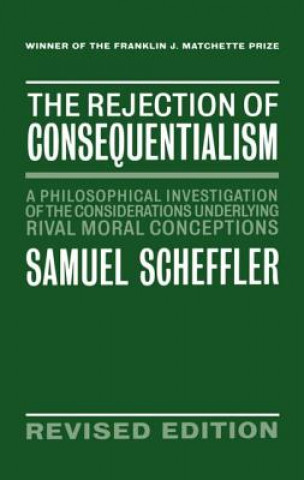
Rejection of Consequentialism
A Philosophical Investigation of the Considerations Underlying Rival Moral Conceptions
 Anglais
 214 b
214 b
Jusqu'à 30 jours pour les retours
Les clients ont également acheté



In contemporary philosophy, substantive moral theories are typically classified as either consequentialist or deontological. Standard consequentialist theories insist, roughly, that agents must always act so as to produce the best available outcomes overall. Standard deontological theories, by contrast, maintain that there are some circumstances where one is permitted but not required to produce the best overall results, and still other circumstances in which one is positively forbidden to to do. Classical utilitarianism is the most familiar consequentialist view, but it is widely regarded as an inadequate account of morality. Although Professor Scheffler agrees with this assessment, he also believes that consequentialism seems initially plausible, and that there is a persistent air of paradox surrounding typical deontological views. In this book, therefore, he undertakes to reconsider the rejection of consequentialism. He argues that it is possible to provide a rationale for the view that agents need not always produce the best possible overall outcomes, and this motivates one departure from consequentialism; but he shows that it is surprisingly difficult to provide a satisfactory rationale for the view that there are times when agents must not produce the best possible overall outcomes. He goes on to argue for a hitherto neglected type of moral conception, according to which agents are always permitted, but not always required, to produce the best outcomes.


À propos du livre
Anglais

Offrez ce livre dès aujourd'hui
C’est simple
1 Ajouter au panier et choisir l'option Livrer comme cadeau à la caisse. 2 Nous vous enverrons un bon d'achat 3 Le livre arrivera à l'adresse du destinataireCeci pourrait également vous intéresser




 /
/
 Livre relié
 36.17
€
36.17
€

 /
/
 Adobe ePub DRM
60.10
€
Adobe ePub DRM
60.10
€
Bonjour ! Je suis Libroamiko, votre conseiller littéraire.
Comment puis-je vous aider ?