
 Contact
 Comment faire ses achats

Livraison
Guide d'achat
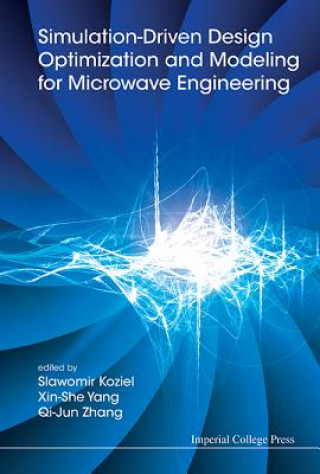
Simulation-driven Design Optimization And Modeling For Microwave Engineering
 Anglais
 465 b
Jusqu'à 30 jours pour les retours
Les clients ont également acheté








 /
 Livre relié
 13.05
€














Computer-aided full-wave electromagnetic (EM) analysis has been used in microwave engineering for the past decade. Initially, its main application area was design verification. Today, EM-simulation-driven optimization and design closure become increasingly important due to the complexity of microwave structures and increasing demands for accuracy. In many situations, theoretical models of microwave structures can only be used to yield the initial designs that need to be further fine-tuned to meet given performance requirements. In addition, EM-based design is a must for a growing number of microwave devices such as ultra-wideband (UWB) antennas, dielectric resonator antennas and substrate-integrated circuits. For circuits like these, no design-ready theoretical models are available, so design improvement can only be obtained through geometry adjustments based on repetitive, time-consuming simulations. On the other hand, various interactions between microwave devices and their environment, such as feeding structures and housing, must be taken into account, and this is only possible through full-wave EM analysis. Electromagnetic simulations can be highly accurate, but they tend to be computationally expensive. Therefore, practical design optimization methods have to be computationally efficient, so that the number of CPU-intensive high-fidelity EM simulations is reduced as much as possible during the design process. For the same reasons, techniques for creating fast yet accurate models of microwave structures become crucially important. In this edited book, the authors strive to review the state-of-the-art simulation-driven microwave design optimization and modeling. A group of international experts specialized in various aspects of microwave computer-aided design summarize and review a wide range of the latest developments and real-world applications. Topics include conventional and surrogate-based design optimization techniques, methods exploiting adjoint sensitivity, simulation-based tuning, space mapping, and several modeling methodologies, such as artificial neural networks and kriging. Applications and case studies include microwave filters, antennas, substrate integrated structures and various active components and circuits. The book also contains a few introductory chapters highlighting the fundamentals of optimization and modeling, gradient-based and derivative-free algorithms, metaheuristics, and surrogate-based optimization techniques, as well as finite difference and finite element methods.


À propos du livre
Anglais

Offrez ce livre dès aujourd'hui
C’est simple
1 Ajouter au panier et choisir l'option Livrer comme cadeau à la caisse. 2 Nous vous enverrons un bon d'achat 3 Le livre arrivera à l'adresse du destinataireCeci pourrait également vous intéresser






 /
Livre relié
39.99
€








 /
Livre de poche
22.40
€


 /
Livre de poche
19.49
€



 /
 Adobe ePub DRM
96.87
€



Bonjour ! Je suis Libroamiko, votre conseiller littéraire.
Comment puis-je vous aider ?