
 Contact
 Comment faire ses achats
Livraison
Guide d'achat
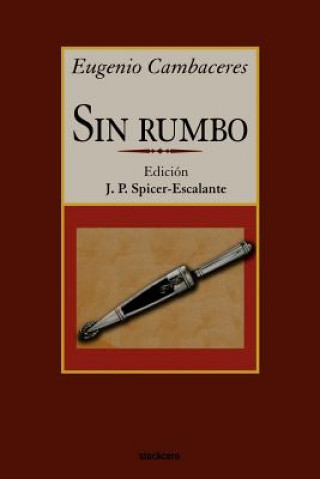
Sin Rumbo
 Espagnol
 55 b
55 b
Jusqu'à 30 jours pour les retours
Les clients ont également acheté


 /
/
 Livre relié
 20.11
€
20.11
€


 /
Livre de poche
28.30
€
/
Livre de poche
28.30
€






 /
Livre de poche
12.73
€
/
Livre de poche
12.73
€


















In Sin Rumbo (1885), the Argentine novelist Eugenio Cambaceres (1843-1889) offers a graphic portrait of the decadence of the Argentine upper class at the end of the Nineteenth Century, as seen through the useless, debauched and violent life of the work's protagonist, the wealthy young estanciero, Andrés. Detailed and vivid, following the precepts of the naturalist school founded by the French author, Emile Zola, Cambaceres defines with literary uniqueness -especially for nineteenth century Latin American literary circles and society in general- the lack of "bearings" of the ruling oligarchy in Argentina and the desastrous effects of this lack of direction on the nation's progress. Given the work's particular aesthetic sense and its penchance for social criticism, this novel became -and remains- a standard-bearer for social change and artistic vision in Latin American letters which should be considered for any course which highlights fin-de-sičcle nineteenth century Hispanic American Narrative in general, as well as other thematics, such as gender issues, the process of nation-building and the development of national culture in particular. In the preliminary study to this text, Prof. J.P. Spicer-Escalante examines the critical reception of literary naturalism in France and Argentina before the publication of Sin Rumbo, the response by Argentine critics to Cambaceres' opus in general, as well as the author's personal vision of naturalist aesthetics and their relationship to social criticism in Sin Rumbo, adding notes that contribute to an in-depth comprehension of Cambaceres' prototypical naturalist novel. This new edition of Cambacere's classic work - fully annotated, conveniently priced and easily available in the US.- is a must for any literature course that highlights fin-de-sičcle nineteenth century Hispanic American Narrative in general, as well as other thematics, such as gender issues, the process of nation-building and the development of national culture in particular.


À propos du livre
Espagnol
Catégories

Offrez ce livre dès aujourd'hui
C’est simple
1 Ajouter au panier et choisir l'option Livrer comme cadeau à la caisse. 2 Nous vous enverrons un bon d'achat 3 Le livre arrivera à l'adresse du destinataireCeci pourrait également vous intéresser
 /
Livre de poche
13.54
€
/
Livre de poche
13.54
€



 /
Livre de poche
14.96
€
/
Livre de poche
14.96
€

 /
Livre relié
33.66
€
/
Livre relié
33.66
€





Bonjour ! Je suis Libroamiko, votre conseiller littéraire.
Comment puis-je vous aider ?