
 Contact
 Comment faire ses achats
Livraison
Guide d'achat
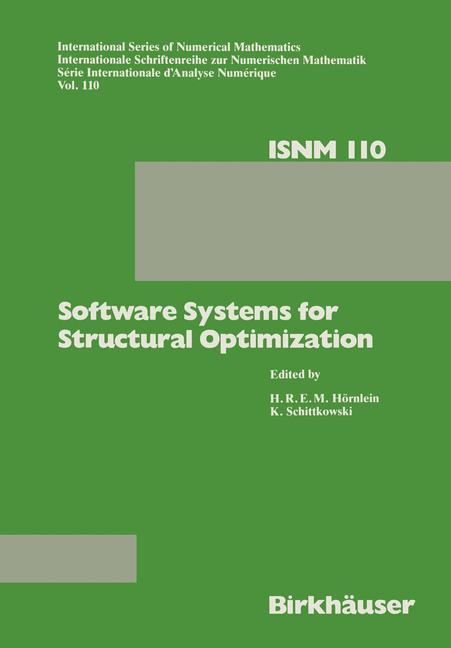
Software Systems for Structural Optimization
 Anglais
 125 b
125 b
Jusqu'à 30 jours pour les retours
Les clients ont également acheté





 /
/
 Livre relié
 43.04
€
43.04
€




 /
Livre relié
29.87
€
/
Livre relié
29.87
€



Herbert Hornlein, Klaus Schittkowski The finite element method (FEM) has been used successfully for many years to simulate and analyse mechanical structural problems. The results are accepted or rejected by means of comparison of state variables (stresses, displacements, natural frequencies etc.) and user requirements. In further analyses the design variables will be updated until the user specifications are met and the design is feasible. This is the primary aim of the design process. On this set of feasible designs, the additional requirement given by an objective function (e.g. weight, stiffness, efficiency, etc.) defines the structural optimization problem. In recent years more and more finite element based analysis systems were ex tended and offer now optimization modules. They proceed from the design model as defined for structural analysis, to perform an internal adaption of design pa rameters based on formal mathematical methods. Despite of many common features, there are significant differences in the selected optimization strategy, the current implementation and the numerical results.


À propos du livre
Anglais

Offrez ce livre dès aujourd'hui
C’est simple
1 Ajouter au panier et choisir l'option Livrer comme cadeau à la caisse. 2 Nous vous enverrons un bon d'achat 3 Le livre arrivera à l'adresse du destinataireCeci pourrait également vous intéresser

 /
Livre de poche
59.15
€
/
Livre de poche
59.15
€







 /
Livre de poche
10.32
€
/
Livre de poche
10.32
€
 /
Livre de poche
109.40
€
/
Livre de poche
109.40
€


 /
Livre relié
50.64
€
/
Livre relié
50.64
€








Bonjour ! Je suis Libroamiko, votre conseiller littéraire.
Comment puis-je vous aider ?