
 Contact
 Comment faire ses achats
Livraison
Guide d'achat
 Anglais
 277 b
277 b
Jusqu'à 30 jours pour les retours
Les clients ont également acheté







 /
/
 Livre de poche
 16.50
€
16.50
€













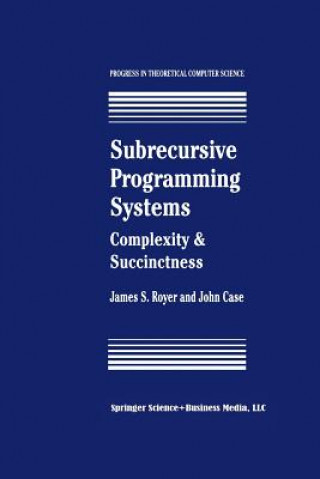
1.1. What This Book is About This book is a study of subrecursive programming systems, efficiency/program-size trade-offs between such systems, and how these systems can serve as tools in complexity theory. Section 1.1 states our basic themes, and Sections 1.2 and 1.3 give a general outline of the book. Our first task is to explain what subrecursive programming systems are and why they are of interest. 1.1.1. Subrecursive Programming Systems A subrecursive programming system is, roughly, a programming language for which the result of running any given program on any given input can be completely determined algorithmically. Typical examples are: 1. the Meyer-Ritchie LOOP language [MR67,DW83], a restricted assem bly language with bounded loops as the only allowed deviation from straight-line programming; 2. multi-tape 'lUring Machines each explicitly clocked to halt within a time bound given by some polynomial in the length ofthe input (see [BH79,HB79]); 3. the set of seemingly unrestricted programs for which one can prove 1 termination on all inputs (see [Kre51,Kre58,Ros84]); and 4. finite state and pushdown automata from formal language theory (see [HU79]). lOr, more precisely, the collection of programs, p, ofsome particular general-purpose programming language (e.g., Lisp or Modula-2) for which there is a proof in some par ticular formal system (e.g., Peano Arithmetic) that p halts on all inputs.


À propos du livre
Anglais

Offrez ce livre dès aujourd'hui
C’est simple
1 Ajouter au panier et choisir l'option Livrer comme cadeau à la caisse. 2 Nous vous enverrons un bon d'achat 3 Le livre arrivera à l'adresse du destinataireCeci pourrait également vous intéresser







 /
Livre de poche
20.75
€
/
Livre de poche
20.75
€


 /
Livre relié
26.93
€
/
Livre relié
26.93
€










Bonjour ! Je suis Libroamiko, votre conseiller littéraire.
Comment puis-je vous aider ?