Contact
 Comment faire ses achats
Livraison
Guide d'achat
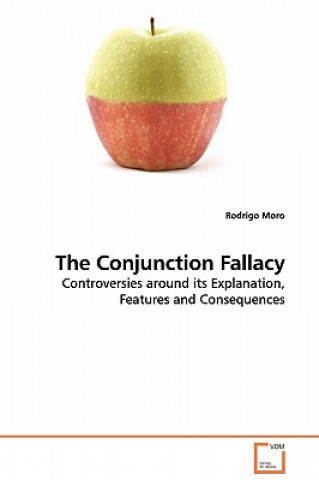
Conjunction Fallacy - Controversies around its Explanation, Features and Consequences
 Anglais
 120 b
120 b
Jusqu'à 30 jours pour les retours
Les clients ont également acheté



 /
/
 Livre de poche
 13.37
€
13.37
€

 /
Livre de poche
38.50
€
/
Livre de poche
38.50
€















In 1983 A. Tversky and D. Kahneman showed that §people sometimes tend to believe that a conjunction §of events (e.g., It rains and it is cold) is more §likely to occur than one of the events at stake §(e.g., It rains). This phenomenon is §called conjunction fallacy as it involves a §logical mistake. Researchers in psychology and §philosophy have engaged in important controversies §around the phenomenon. This work explores three of §these debates. First, it addresses the issue §of the nature of the conjunction fallacy. Is the §conjunction fallacy mainly due to a misunderstanding §of the problem by participants or is it mainly due §to a genuine reasoning bias? Second, it explores §empirical controversies about the factors that §elicit or help to avoid the fallacy. Third, it deals §with the impact of the conjunction fallacy studies §on the issue of human rationality. Does the fact §that most people commit the conjunction fallacy §imply that human beings are in some contexts §irrational? This book should help shed some light on §these debates and should be of interest of §psychologists, philosophers or anyone interested in §the tricks of the human mind.


À propos du livre
Anglais
Catégories

Offrez ce livre dès aujourd'hui
C’est simple
1 Ajouter au panier et choisir l'option Livrer comme cadeau à la caisse. 2 Nous vous enverrons un bon d'achat 3 Le livre arrivera à l'adresse du destinataireCeci pourrait également vous intéresser


 /
Livre relié
56.34
€
/
Livre relié
56.34
€