
 Contact
 Comment faire ses achats
Livraison
Guide d'achat
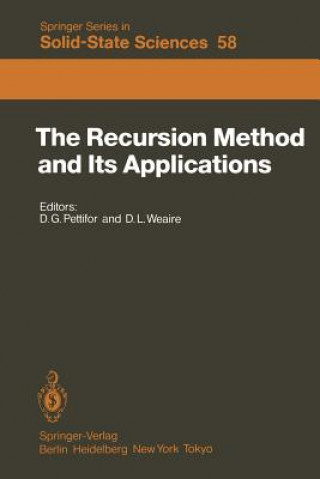
Recursion Method and Its Applications
Proceedings of the Conference, Imperial College, London, England September 13-14, 1984
 Anglais
 249 b
249 b
Jusqu'à 30 jours pour les retours
Les clients ont également acheté













This volume reviews recent advances in the development and application of the recursion method in computational solid state physics and elsewhere. It comprises the invited papers which were presented at a two-day conference at Imperial College, London during September 1984. The recursion method is based on the Lanczos algorithm for the tridiago nalisation of matrices, but it is much more than a straightforward numerical technique. It is widely regarded as the most elegant framework for a variety of calculations into which one may incorporate physical insights and a num ber of technical devices. The standard reference is Volume 35 of Solid State Physics, which contains all the early ideas of Heine, Haydock and others, upon which the method was established. The present volume provides the first review of subsequent developments. It also indicates where problems remain, or opinions differ, in the interpretation of the mathematical details or choice of practical techniques in applications. The field is still very li vely and much remains to be done, as the summary chapter clearly demonstra tes. We are grateful to the S. E. R. C. 's Collaborative Computational Project No. 9 on the electronic structure of solids and the Institute of Physics's Solid State Sub-committee for their sponsorship of the conference. We thank Angus MacKinnon for his help in conference organisation and Jacyntha Crawley for secretarial assistance. December 1984 David G. Pettifor Denis L. Weaire v Contents Part I Introduction Why Recur? By V.


À propos du livre
Anglais

Offrez ce livre dès aujourd'hui
C’est simple
1 Ajouter au panier et choisir l'option Livrer comme cadeau à la caisse. 2 Nous vous enverrons un bon d'achat 3 Le livre arrivera à l'adresse du destinataireCeci pourrait également vous intéresser
 /
/
 Livre de poche
 11.22
€
11.22
€
 /
Livre de poche
9.50
€
/
Livre de poche
9.50
€






 /
Livre relié
38.24
€
/
Livre relié
38.24
€



 /
Livre relié
36.41
€
/
Livre relié
36.41
€






 /
Livre de poche
29.84
€
/
Livre de poche
29.84
€
 /
Livre relié
42.99
€
/
Livre relié
42.99
€

Bonjour ! Je suis Libroamiko, votre conseiller littéraire.
Comment puis-je vous aider ?