
 Contact
 Hoe winkelen bij ons werkt
Bezorging
Winkelgids
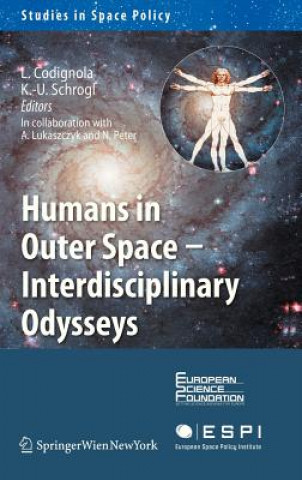
Humans in Outer Space - Interdisciplinary Odysseys
 Engels
 249 b
249 b
Tot 30 dagen retourrecht
Klanten kochten ook







 /
/
 Gebonden (paperback)
 36.01
€
36.01
€















 /
Gebonden (paperback)
25.18
€
/
Gebonden (paperback)
25.18
€


 /
Gebonden (paperback)
30.75
€
/
Gebonden (paperback)
30.75
€

 /
Gebonden (paperback)
98.44
€
/
Gebonden (paperback)
98.44
€


 /
Gebonden (paperback)
40.97
€
/
Gebonden (paperback)
40.97
€

 /
Gebonden (paperback)
38.34
€
/
Gebonden (paperback)
38.34
€

Humans and space When faced with the issue of space exploration, one generally has an idea of the ?elds of study and disciplines that are involved: technology, physics and chemistry, robotics, astronomy and planetary science, space biology and medicine, disciplines which are usually referred to as the ?sciences?. In recent discussions, the human element of space exploration has attracted more and more the interest of the space sciences. As a consequence, adjacent disciplines have gained in relevance in space exploration and space research, in times when human space ?ights are almost part of everyday life. These disciplines include psychology and sociology, but also history, philosophy, anthropology, cultural studies, political sciences and law. The cont- bution of knowledge in these ?elds plays an important role in achieving the next generation of space exploration, where humans will resume exploring the Moon and, eventually, Mars,and wherespacetourism isbeginningtobedeveloped. With regard to technology, one might soon be prepared for this. Much less is this the case with space exploration by humans, rather than by robots. Robotic explorations to other planets across the solar system have developed in the past 50 years, since the beginning of the ?space age? with the presence of humans in nearby space and the landing on the Moon. Space exploration is now not only focused on technological achievements,asitsdevelopmentalsohassocial,culturalandeconomicimpacts. This makes human space exploration a topic to address in a cross-disciplinary manner.


Informatie over het boek
Engels

Geef dit boek vandaag nog cadeau
Dat gaat heel eenvoudig
1 Voeg het boek toe aan je winkelwagentje en selecteer Als cadeau bezorgen 2 Je krijgt van ons per omgaand een voucher 3 Het boek wordt bezorgd op het adres van de ontvangerDit vind je misschien ook interessant


 /
Gebonden (harde band)
262.04
€
/
Gebonden (harde band)
262.04
€


 /
Gebonden (harde band)
109.97
€
/
Gebonden (harde band)
109.97
€


















 /
Gebonden (paperback)
14.86
€
/
Gebonden (paperback)
14.86
€

Hoi! Ik ben Libroamiko, je boekadviseur.
Hoe kan ik je helpen?