
 Contact
 Hoe winkelen bij ons werkt
Bezorging
Winkelgids
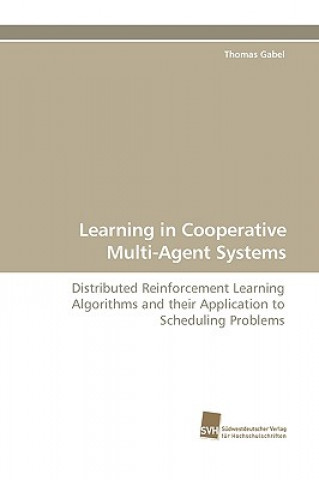
Learning in Cooperative Multi-Agent Systems
Distributed Reinforcement Learning Algorithms and their Application to Scheduling Problems
 Duits
Duits
 172 b
172 b
Tot 30 dagen retourrecht
Klanten kochten ook














 /
/
 Gebonden (paperback)
 11.19
€
11.19
€






 /
Gebonden (paperback)
76.95
€
/
Gebonden (paperback)
76.95
€










In a distributed system, a number of individually acting agents coexist. In order to achieve a common goal, coordinated cooperation between the agents is crucial. Many real-world applications are well-suited to be formulated in terms of spatially or functionally distributed entities. Job-shop scheduling represents one such application. Multi-agent reinforcement learning (RL) methods allow for automatically acquiring cooperative policies based solely on a specification of the desired joint behavior of the whole system. However, the decentralization of the control and observation of the system among independent agents has a significant impact on problem complexity. The author Thomas Gabel addresses the intricacy of learning and acting in multi-agent systems by two complementary approaches. He identifies a subclass of general decentralized decision-making problems that features provably reduced complexity. Moreover, he presents various novel model-free multi-agent RL algorithms that are capable of quickly obtaining approximate solutions in the vicinity of the optimum. All algorithms proposed are evaluated in the scope of various established scheduling benchmark problems.


Informatie over het boek
Duits
Categorieën

Geef dit boek vandaag nog cadeau
Dat gaat heel eenvoudig
1 Voeg het boek toe aan je winkelwagentje en selecteer Als cadeau bezorgen 2 Je krijgt van ons per omgaand een voucher 3 Het boek wordt bezorgd op het adres van de ontvangerDit vind je misschien ook interessant













 /
Gebonden (paperback)
22.18
€
/
Gebonden (paperback)
22.18
€







Hoi! Ik ben Libroamiko, je boekadviseur.
Hoe kan ik je helpen?