
 Contact
 Hoe winkelen bij ons werkt
Bezorging
Winkelgids
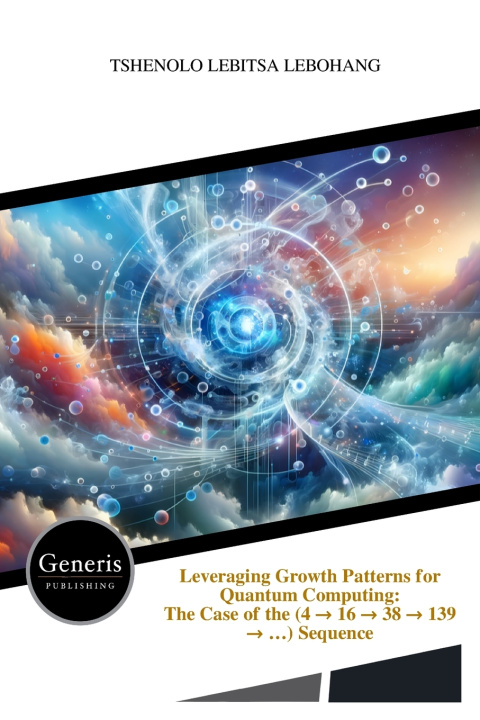
Leveraging Growth Patterns for Quantum Computing
The Case of the (4 → 16 → 38 → 139 → ...) Sequence
 Engels
 73 b
73 b
Tot 30 dagen retourrecht
Klanten kochten ook




The paper "Leveraging Growth Patterns for Quantum Computing" argues that progress in quantum computing does not follow smooth exponential curves but instead occurs through irregular leaps. Using the sequence (4 → 16 → 48 → 139 → ...) as a framework, the author suggests that breakthroughs in areas like logical qubit scaling, error correction, connectivity, coherence, and algorithms often happen when multiple innovations align, triggering step-changes in capability.
The paper develops mathematical models (recurrence relations, percolation thresholds, Bayesian change-point detection) to formalize this leap-based growth and provides case studies across superconducting, trapped-ion, and emerging topological qubit platforms. It emphasizes the need for modular architectures, milestone-driven roadmaps, and high-risk/high-reward funding strategies, since small improvements can suddenly combine to produce major advances.
Overall, the work offers a new lens for forecasting and guiding quantum computing progress, shifting attention from steady qubit counts to discrete breakthroughs that redefine the trajectory of the field.


Informatie over het boek
Engels
Categorieën

Geef dit boek vandaag nog cadeau
Dat gaat heel eenvoudig
1 Voeg het boek toe aan je winkelwagentje en selecteer Als cadeau bezorgen 2 Je krijgt van ons per omgaand een voucher 3 Het boek wordt bezorgd op het adres van de ontvangerHoi! Ik ben Libroamiko, je boekadviseur.
Hoe kan ik je helpen?