
 Contact
 Hoe winkelen bij ons werkt
Bezorging
Winkelgids
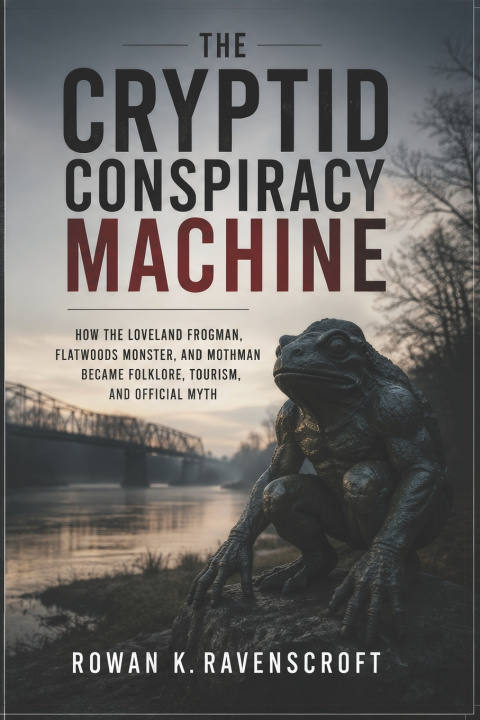
The Cryptid Conspiracy Machine
How the Loveland Frogman, Flatwoods Monster, and Mothman Became Folklore, Tourism, and Official Myth
 Engels
 36 b
36 b
 Nieuw
Nieuw
Tot 30 dagen retourrecht
Klanten kochten ook



 /
/
 Leporello (harmonicaboek)
 9.07
€
9.07
€

What becomes official when an unproven monster enters the public record?
The Loveland Frogman, the Flatwoods Monster, and Mothman are usually treated as strange sightings, local legends, or paranormal mysteries. But the deeper story is not only whether these creatures were ever real. It is how uncertain claims became civic symbols, tourism engines, public rituals, and official-adjacent myths.
The Cryptid Conspiracy Machine follows three American legends through the gap between record and rumor. In Loveland, Ohio, a river creature moves from disputed roadside accounts into mascot culture, festival framing, and state-symbol conversation. In Braxton County, West Virginia, the Flatwoods Monster shows how one frightening night can become an image strong enough to support museums, souvenirs, visitor routes, and local identity. In Point Pleasant, Mothman reveals what happens when a creature story becomes attached to disaster, memory, warning, and grief.
This is not a book that asks readers to accept every monster claim as proof. It is also not a book that mocks witnesses or flattens folklore into foolishness. Instead, it separates what is documented from what is alleged, what institutions recognize from what evidence can verify, and what communities preserve from what science can confirm.
At the center of the book is a careful question: how do stories become culturally real when the proof remains incomplete? A city can celebrate folklore without proving biology. A museum can preserve a legend without settling the original sighting. A festival can give a town a symbol without requiring every visitor to believe. A legislature can name a cryptid as cultural material without producing a specimen. Those distinctions are fragile, and this book examines why the public so often feels that official attention means something stronger than it actually does.
Across the Loveland, Flatwoods, and Mothman cases, the same pattern begins to appear: ambiguous event, witness claim, evidence gap, skeptical explanation, media amplification, local adoption, tourism conversion, and symbolic recognition. The machine does not require a hidden mastermind. It works through ordinary incentives-attention, uncertainty, civic pride, economic usefulness, memorable imagery, and the human desire for mysteries that do not close neatly.
The reading experience is investigative, atmospheric, and evidence-aware. The book moves through sightings, corrections, museums, festivals, official language, skeptical explanations, and public memory while keeping one boundary clear: recognition is not verification. The monsters may remain unproven, but the systems built around them are visible.
For readers interested in cryptids, folklore, media culture, tourism, public records, and the strange life of American legends, The Cryptid Conspiracy Machine offers a disciplined look at how weak evidence can become strong myth-and how unresolved stories keep finding new ways to enter the daylight.


Informatie over het boek
Engels

Geef dit boek vandaag nog cadeau
Dat gaat heel eenvoudig
1 Voeg het boek toe aan je winkelwagentje en selecteer Als cadeau bezorgen 2 Je krijgt van ons per omgaand een voucher 3 Het boek wordt bezorgd op het adres van de ontvangerDit vind je misschien ook interessant






 /
Gebonden (harde band)
136.85
€
/
Gebonden (harde band)
136.85
€